


DESCRIPTION
MULTIPLAST uses vacuum-prepreg fabrics and sheets with oven or autoclave polymerisation to manufacture monolithic or foam and/or honeycomb sandwich composite structures. This technology is particularly suited to the manufacture of composite parts with very high mechanical requirements.
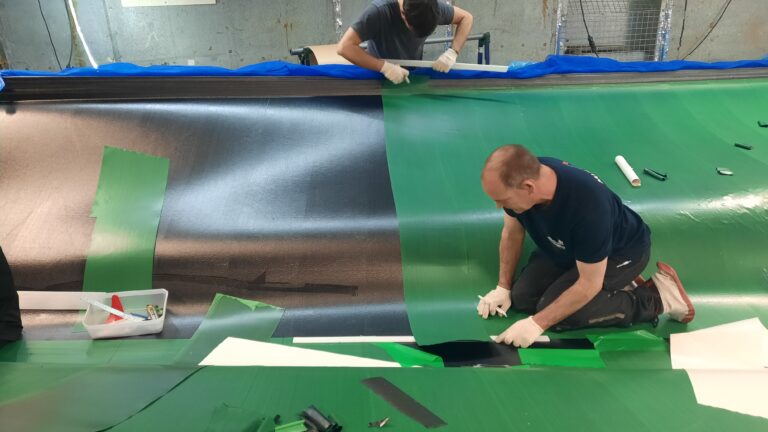
This process consists of:
- Store and handle prepregs under controlled conditions (temperature and humidity) in order to preserve their properties.
- Cut pleats manually or mechanically, then position them in the mould, in a controlled atmosphere, according to the designers' draping plan.
- Compact regularly under vacuum to remove air and ensure low porosity.
- Cure by baking (80°C to 180°C depending on the resin system) in an autoclave or oven at a defined pressure and temperature in order to obtain optimal mechanical properties.
Main advantages of this process:
- Very good fibre/resin ratio,
- High and repeatable mechanical properties,
- Low porosity (1 to 3% in an oven and below 1% in an autoclave),
- Possibility of using honeycomb for sandwich structures,
- Possibility of producing very large parts,
- Excellent working environment thanks to the limitation of solvent and volatile organic compound emissions.
- Excellent repeatability of parts thanks to rigorous control of production parameters.
- Very tight dimensional and mass tolerances, suitable for the most demanding industries.
- High-quality surface finish, reducing the need for post-processing operations.
- This technology is favoured in sectors such as aeronautics, space, ocean racing and motor sports, where lightness, rigidity and reliability are key criteria.
At MULTIPLAST, this process is used for the following parts:
- Competition boats (Ultim, IMOCA, Ocean50, AC75),
- Helicopter flight simulators,
- Antennas, radars, radomes and sonars,
- Bellmouths (moteurs GENERAL ELECTRICS GENX),