


“Argo should allow us to continue writing the History of great records”
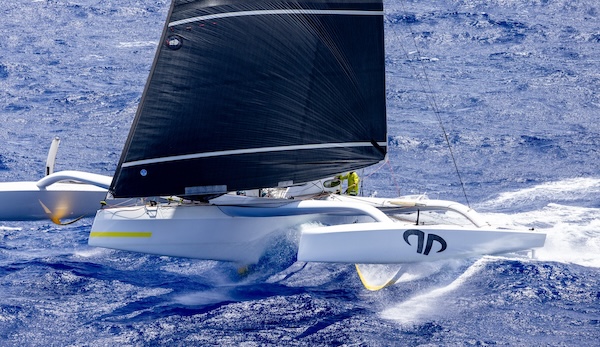
The American team Argo officially announced in mid-April the launch of an Ultim-sized multihull (32 meters long and 23 meters wide), with the ambition, starting in 2029, of taking on a whole series of ocean records. For the design, the team called on VPLP Design, while Multiplast was entrusted with the construction. Explanations from its CEO, Yann Penfornis.
How did this trimaran project come about?
Quentin Lucet (partner architect at VPLP Design) had told me about it two years ago, and at the time, with a heavy heart, I told him that we would not be able to do it because we were too busy with the AC75 and the Imocas. The nature of projects meant that this one was pushed back in time, and when Quentin came back to us in January to ask whether we wanted to respond to the tender for this Ultim-sized trimaran, we obviously said that the project interested us. First because working again on a boat whose ambition is to take on the great records was something that particularly motivated us, and secondly because the proposed schedule this time fit perfectly into Multiplast’s industrial planning, in the sense that we will have almost completed our Imoca cycle: DMG Mori has already been delivered, Paprec will be nearly finished by the end of the year, and we will be in the final phase of constructing her sistership, 4CAD, Benjamin Dutreux’s boat
How did the project then take shape?
We first met Chad (Corning, who heads Team Argo) two days after the arrival of Sodebo Ultim 3 in the Jules Verne Trophy; it was the ideal moment to talk about large record-breaking boats built at Multiplast, since Thomas Coville and his crew had just earned us the shipyard’s seventh Jules Verne Trophy! Then, throughout the month of February, the team in charge of estimates at Multiplast and Samuel Napoleoni, who is overseeing the project, worked extensively to be able to present a strong proposal at the beginning of March. At the end of that meeting, it was agreed that we would receive an answer by the end of the month, and it arrived just a few hours before April 1st, on March 31st around 9 p.m.! As a side note, I received Chad’s email right in the middle of a Sailorz Film Festival screening in Vannes, during the film about Charlie Dalin’s victorious Vendée Globe. I took it as a sign of destiny, and it gave us a wonderful opportunity to offer a beer during the intermission to the VPLP team, who were sitting a few seats ahead of us!
How attached is Multiplast to this type of boat?
An old ad from the 1980s described Multiplast as being “the shipyard of records”. I believe the shipyard has held the Atlantic record six times, and the Jules Verne Trophy has always been part of its history, since we built the first holder, Commodore Explorer, and the latest, Sodebo Ultim 3, but also Orange, Geronimo, Orange II, and Groupama 3, which became Idec Sport, all of which also broke the record. We hope that being chosen by Argo for this project will allow us to continue writing this long history. Gilles Ollier (founder of Multiplast), who is one of my mentors, long said that these multihulls were not designed to be sailed solo because a single skipper cannot exploit 100% of the machine’s potential. The advantage of working on a crewed boat from the design stage is that the human factor will not be limiting, as can be the case for an Ultim that has to race the Route du Rhum. Everything is designed around the crew, and that is incredibly enjoyable!
How will you organize the teams to build this trimaran?
As I mentioned, it is Samuel Napoleoni, who worked on the AC75 of the French K-Challenge team and has just completed DMG Mori, who is taking charge of the project. He obviously will not be alone because there are many sub-projects on a boat like this: the crossbeams, the central hull, the floats. Twenty-five years ago, on a boat like Orange II for example, we designed the plans, the platform, the appendages, the mast, the boom, the beams, absolutely everything! Today, this is a sector in which many players have specialized, and on our side, we are delighted to focus solely on manufacturing the platform, which is already a very major undertaking. We are going to fully commit ourselves for two years, knowing that since construction will not begin before December, we have time to anticipate things properly. This is also one of the strengths of this program, which is not built around a race start date. Such a schedule allows VPLP, the designers, to properly plan the work for a year and then allows Multiplast to build calmly during the following two years.
Will you have to adapt your tools for the construction of this future Argo?
No, because of our history, we already have extensive resources in place. I believe that in total, we have built 25 hulls for this type of boat (central hulls and floats for trimarans and catamarans). So our production tools already exist, and such a construction does not require building another hall. However, it does require very precise space organization, because a multihull of this size takes up a great deal of room, but we are now highly experienced with this type of process.
IN BRIEF
RACING. The winter of 2025-2026 provided Multiplast with the opportunity to add to its record book: Sodebo Ultim 3, built in Vannes, got things underway at the end of January by claiming the Jules Verne Trophy in 40 days, 10 hours, and 45 minutes, improving by just under 13 hours the time set in 2017 by Idec Sport. The following day, the latter, with Alexia Barrier and seven female sailors on board, completed the same course in 57 days, 21 hours, and 20 minutes, setting the first benchmark time for an all-female crew and marking another historic moment for this trimaran launched by Multiplast in 2006 (two-time Jules Verne Trophy holder, three-time Route du Rhum winner). Finally, MACSF, the former Geronimo launched in 2001 and also built by Multiplast, with Guirec Soudée at the helm, broke the reverse around-the-world record in 94 days, 21 hours, and 58 minutes, with the Breton becoming the first person to complete this course on a multihull.
RACING. After more than 40,000 hours of manufacturing, DMG Mori, Kojiro Shiraishi’s new Imoca was delivered in mid-March to the DMG Mori Sailing Team and will be officially unveiled on June 4 in Lorient. According to Jeremy Mazzolini, head of the design office, “it was interesting to develop this complex structure with Kojiro’s team, and we were also very pleased to collaborate once again with Guillaume Verdier, who lived up to his reputation as an architect who is innovative in both shapes and structural optimization.”
TRANSPORT. Orient Express Corinthian, the very first luxury cruise ship from the Accor Group, equipped with three SolidSail rigs and sails made of fiberglass and carbon fiber panels manufactured at Multiplast, was inaugurated on April 29 at the Chantiers de l’Atlantique site in Saint-Nazaire. During the sea trials, the vessel reached a speed of 12 knots under sail alone, without engine assistance, and the first commercial voyages are currently beginning in the Mediterranean.
AERONAUTICS. Multiplast has just completed the construction of a new series of six bellmouths, air intakes ordered last autumn by Safran Aero Boosters and intended for the LEAP aircraft engine test benches used by Airbus and Boeing (see our December 2024 newsletter).
DEFENSE. Having been involved for more than 15 years in the manufacture of radomes for Thales (radar panels designed to protect them from environmental damage, see our December 2024 newsletter), Multiplast is about to complete the production of the hundredth piece in this series for Ground Master 200 radars.
RACING. 11th Hour Racing, the former Malizia of Boris Herrmann (built at Multiplast), now sailed by Italian-American Francesca Clapcich, was relaunched at the end of March in her new colors. She finished fifth on May 8 in her very first solo Imoca race, the 1000 Race. In the same race, Corentin Horeau took second place aboard MACSF, the former Paprec Arkéa of Yoann Richomme, launched by Multiplast in February 2023.
AERONAUTICS. Construction of the very first float for the future FF72 water bomber aircraft on behalf of Positive Aviation (see our May 2025 newsletter) is underway. The composite parts of this first float will then be sent to Airbus’ Technocentre in Nantes, where assembly will take place. The first flight is scheduled for the end of the year; the FF72 will be presented at the Paris Air Show in Le Bourget in June 2027, and the first customer delivery is planned for the 2028 season.
RACING. A double win for Elvest! The Ocean Fifty skippered by Sébastien Rogues and built by Multiplast in 2022-2023 made a flying start to the Ocean Fifty Series season by winning Acts 1 and 2 in early May in Sainte-Maxime and then Ajaccio. Next up, this time solo with Matthieu Perraut at the helm, is the Drheam-Cup from July 9 to 18.
An astronomical meridian for Université Paris Cité
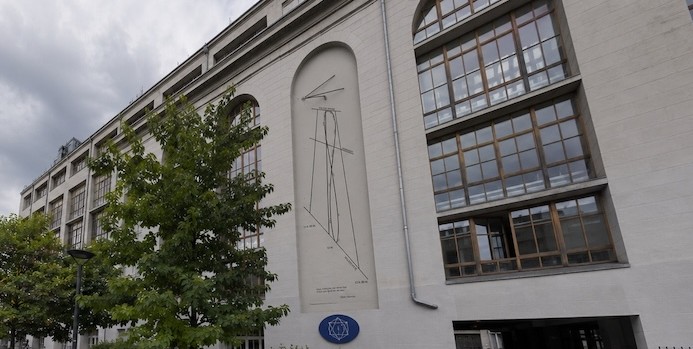
At the end of May, Multiplast will install a carbon astronomical meridian on one of the buildings of Paris Cité University, on the Grands Moulins campus in the 13th arrondissement. An unusual project requiring millimeter-level precision adjustments.
© Université Paris Cité
Designed by the Lemoal Architectes firm and produced by Multiplast, this large-scale meridian – 12 meters high and 3.50 meters wide – will be mounted at the end of May inside a niche on one of the southeast-facing facades of Paris Cité University. It consists of a large carbon-epoxy panel engraved with a giant figure eight representing the path of the sun across the sky throughout the year, as well as its trajectories during the solstices and the equinox.
“It makes it possible to tell the time, the day, and the month at the moment of solar noon, explains Sylvain Chaty, Vice President Delegate for Culture, Science and Society at Paris Cité University and an astrophysicist by training. When the sun is low in winter, the sunspot appears rather high up, and when it is high, the spot appears lower down. The idea was to create an object that is at once aesthetic, educational, and historical, linking back to the first sundials dating from the time of the Sumerians, 5,000 or 6,000 years ago.”
If Multiplast won the tender, “it was largely thanks to the choice of material, carbon, because it does not expand with heat and therefore maintains the meridian’s precision throughout the year, but also thanks to their “living heritage company” label, which aligns well with the values of the University, continues Sylvain Chaty. According to our research, this would also be the first meridian ever made of carbon, since traditionally they are either engraved in stone or painted.”
On the Multiplast side, Jérémy Mazzolini, head of the design office, is delighted with this collaboration, which enabled the company to broaden its expertise: “It was interesting to understand the technical and astronomical challenges of this ancient object in order to meet its precision requirements through the use of a relatively modern material such as carbon and fairly advanced engineering techniques.”
After scanning the facade of the Grands Moulins building in Paris, the Multiplast team had a large carbon panel machined at Ouest Composites (a member of the Carboman group, like Multiplast) using its large-scale numerically controlled machine. Then, based on the coordinates of the analemma projection (the figure-eight path followed by the sun across the sky throughout the year) calculated by Denis Savoie, astrophysicist and world expert on meridians and sundials, “we created the digital model of the meridian in our 3D design tools,” specifies Jérémy Mazzolini.
Installed in April, the fixings had to be adjusted with precision, he continues: “The parallel alignment with the facade and the vertical positioning of the piece require millimeter-precise adjustment to guarantee the accuracy of the meridian. The oculus, the perforated disk through which the sun’s rays pass, is adjusted using a laser tracker, and its tripod support system positioned 2.50 meters away from the panel also required an engineering challenge and millimeter-level precision adjustment.”
Finally, tradition dictates that a meridian should include a motto, and Paris Cité University chose to engrave this quote by Diderot from 1767: “Everything vanishes, everything perishes, everything passes: only time endures.” The whole structure was then painted white-grey to blend in as seamlessly as possible with the facade. “Between the design, machining, lay-up, painting, as well as the installation and adjustment of this large-scale piece, many different areas of expertise were called upon for this achievement,” concludes Jérémy Mazzolini.
How Multiplast ensures workplace safety
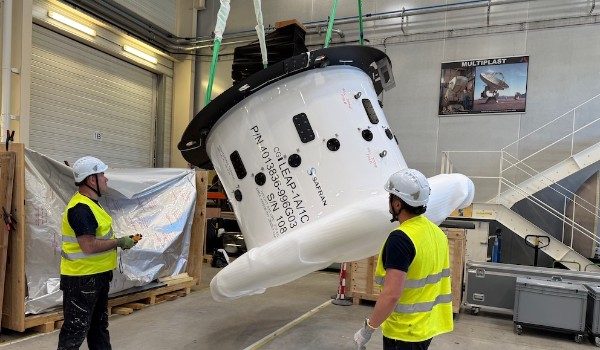
Prevention, organization, and anticipation are at the heart of Multiplast’s safety approach. For each of its projects, the company plans ahead for access and possible workstation arrangements in order to secure and improve working conditions.
© François Martin / Multiplast
“We make sure that the safety culture is not driven solely by management but is truly shared by all employees so that they embrace it on a daily basis, introduces Arnaud Buan, Hygiene, Safety and Environment Manager at Multiplast for the past six years. In particular, we encourage collective vigilance and care for one another in order to move toward zero accidents and to report risky or dangerous situations.”
Prevention is one of the first pillars Arnaud Buan relies on to improve workplace safety. “Regarding chemical risks linked to the use of resins, we of course have collective protective equipment (extraction systems, air renewal, ventilation…), but there is still work to be done on risk awareness to change habits, so that wearing personal protective equipment (masks, gloves, goggles) becomes systematic,” he explains.
Particular attention is also paid to operators’ postures in order to improve their working conditions. “They handle large parts and sometimes work in confined spaces and with constrained positions for which we must find solutions, explains Arnaud Buan. As we are often working on prototypes, the tasks are not repeated and automated, as they might be in other industries. There are regularly new situations that require adaptation and on which we work upstream with the design office.” For the construction of certain Imocas, he explains for example that “the sequencing of the manufacturing stages was redesigned so that the deck could be closed at the very last moment to facilitate movement inside the hull”;
In order to anticipate all aspects related to organization and safety before projects begin, Multiplast also created a new position in July 2025: Thomas Lempérière, Production Industrialization Coordinator, acts as the link between the design office and the operators in order to put in place everything the team will need to work safely. “Depending on the position, height, and ergonomics of the mold, I anticipate scaffold heights, think about stairways for access, and carry out simulations of body postures to make the employees’ work easier,” he explains.
Well placed to understand these issues, since he joined Multiplast 27 years ago, first as an operator and then as a team leader, he adds: “I also install equipment such as cutting tables and lighting. Today, all this work no longer has to be done in parallel with production, and on the day the project begins, the operators arrive in a space that is already safe and operational. I then support the project launch to assess its feasibility and safety and to pass on my experience.”
Currently, a team of six operators is also undergoing training “to meet a need for greater safety control and to help bring more peace of mind into daily work situations, by thinking for example about operating procedures for turning over large-scale parts,” Arnaud Buan also points out.